Mari’s Blog
A Course of Love’s Labor Day publication
The future is yet to be created. T4:11.1
 Rain just started falling. And stopped. A car goes by. It’s Sunday morning. I wait. I’m waiting for the silence between cars. While I wait the rain starts again. And stops. lt’s as if it’s mimicking the cars. Then there it is, almost before it registers, a moment filled with silence. Then thunder. A lovely breeze. Near silence again. Thunder again.
I’ve been aware of the intermittent and the transitional lately. July flew by like today’s breeze. But the two transitional months that bookend it have stretched to the max. Having my grandson with me, June was the leaving of school and the settling into summer; August the leaving of summer and preparing for school. In transitional times, you don’t know what life will bring and you’re aware you don’t know what life will bring. I think these times get elongated because of that awareness. You’re excited. Expectant. Hopeful. Nervous. The anticipation! In mere days, life will be new. New! Who knows what’s on the horizon?

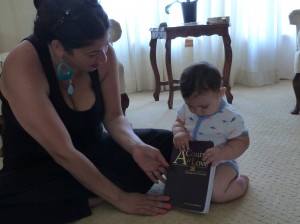
Today is my daughter Mia’s birthday. Here she is showing my grandson Jack the new edition of ACOL
A Course of Love: Combined Volume, has an official publishing date of September 1, which, this year, is Labor Day, the day before the first day of school for a good portion of the United States and maybe other countries as well. At first this didn’t seem like a great day to me. But now, I feel that a time when so many children, young adults, parents, teachers and administrators are standing on the edge of newness, has to be a time of good energy for a new publication. Instead of “thinking you know” how life will go, you exist at such times, in between, in a pause, open to the newness.
When I wrote the Love book of The Grace Trilogy, (the start of my spiritual journey, shared with two friends), I said, “As ordinary women, we were used to our lives proceeding in an orderly fashion, to having the kind of years difficult to discern from any other year. The unusual years were just that: unusual. We might remember the year we got married, be able to place our state of mind by remembering the years in which our children were born or some other major event took place. “Oh, yes, that was the year . . .””
When we began to review, to think of telling our story, it was then that we realized what an unusual year we had lived. Sometimes a month felt like a year. A day, even an hour, could change us irrevocably. When we got together recently we each were saying, “I wouldn’t be who I am, my life wouldn’t be what it is today, without that time we spent together.” The experiences we shared were, for me, like a prelude to the coming of A Course of Love. The newness just kept continuing on.
One of the things that feels new about A Course of Love (even if it isn’t so new if you think biblically) is that it takes us to the mountain top but returns us to level ground. The cyclical nature of “life on the ground” goes on alongside “life in the spirit” or whatever you want to call the deep inner earthquakes that flash in and out of “usual” life and make for the “unusual,” the unexpected, the extraordinary. I love it. I love it that I could never in my wildest imaginings have predicted for myself the life that I have. I love every reminder that the future is yet to be created.
“Many predictions of the future have been made, and many of them have been called prophecy. But the future is yet to be created.” T4:11.1
Sunday morning in the cabin . . . Good to go
 It is both odd and encouraging when you have a very fine dream, don’t you think? Last night I had the first epic dream I’ve had in a while. In it, I’m being drawn, as if by clues. Nothing is spelled out. I am being carried along by the experience of it, going along without meaning to go, but realizing after I am on my way that I was ready to go all along. This morning, writing of it, I know I have the same general feeling about life right now. I am being carried along. I don’t know that I’m ready for what is happening until it is happening and I’ve been started on my way. Then, Yes. I am ready. I have been ready a long while. Musing on this I kept hearing the voice of Jodie Foster in the movie “Contact,” the scene where she thinks she’s about to test a vehicle that will take her into space—something she’s always wanted to do, and as the thing shakes and she vibrates with its energy, she won’t stop saying,“I’m good to go.”
Somehow, what we love makes us “good to go” . . . even if we don’t know it or decide it or have much to do with the propellant.
A Course of Love is a big love of mine. Its republication is a good part of the reason for the feeling of similarity between life and the dream. Clues are dropped, actions are happening, I’m being drawn along by a thing in motion. I have ceased to be the vehicle. I am no longer doing the physical things I used to carry out. I am being carried. It almost brings tears to my eyes, tears and a Hey wait a minute, I don’t know how to do this feeling. Because this isn’t a “creative” getting carried, which I’m as used to as a person can ever be amid the joy and surprise of it, but a carried along that is about external as well as internal life.
Writing and the inner life have been both my work and my passion for a long while. Family is a third great love and since I have my seven-year-old grandson Henry living with me right now, my cabin time isn’t as great as it once was, and as soon as I get a chance, the cabin is where I come and writing is what I do. Writing and reading. My love affair with writing is most evident in my journal writing. I write because when I write I see what I didn’t see before, and when I read journals I meet other people for whom this is true.
Lately I have been accompanying Joyce Carol Oates out of the seventies decade. I leave her tome of a book in the cabin, and the days of it go by slowly along with mine. Today I am with her as 1980 begins and she’s musing that the spiritual side of her nature is largely in eclipse.
In 1997 a journal of mine was published as part of The Grace Trilogy. Take Heart is reissuing the books of the Trilogy as ebooks (Love, Grace, and Peace) in a month or so. As I reviewed Peace, I kept thinking how I “didn’t see.” That’s what journals show too. Even the great Thomas Merton didn’t see until he saw. And as I read JCO telling of her spiritual nature being in eclipse, I know it is not so. She says: “I sometimes feel like a shadowy self has taken me over. A superficial though charming—I suppose charming!—“social” personality. But the deeper person, the spirit, the psyche, remains stubbornly hidden.”
The rich ground of being is always such . . . until it is not.
True nature
If you allow your potential to be released, your true nature in all its wholeness will be revealed.
This past Sunday was an unusual Sunday. In my church there is a once a year Mass in the Park. Generally this is on Saturday evening at the time of the regular Saturday night Mass, but there must have been something going on at the park and it was scheduled for Sunday instead. It’s funny how such things can throw you off. I generally accompany my mom to church on Saturday night and so in that way of things grown routine, waking up the next morning I expected Sunday morning quiet.
 On Sunday mornings I am enjoying the quietest morning of the week in my cabin. Donny, my husband, built it for me in the woods behind our yard. What I call the woods are an overgrown half acre of land that runs next to the freeway fence. Every once in a while, if I’m up early enough on Sunday morning, there are a few seconds of silence.
I like those quiet mornings, but it no longer matters much (most  days). The cabin holds silence. I walk in and the look of it says silence. It is my quiet place.
When I reflect back on the years of A Course of Love, (which is something you do when you have your work compiled, especially when you have an editor who asks a lot of questions!) one of the sure things I know is that it led me here, to the cabin. She, the cabin, came to me as my Course of Love miracle. The day after I finished the last page of The Dialogues, my husband got a phone call that the land was for sale as tax forfeited property, which meant at a price we could afford. It had been my fondest wish—to own the land and have a place on it to which to retreat. A couple of years later the materials for the cabin came in a similarly miraculous way. But really, that is such a small part of what I mean when I say ACOL led me here. It led me here through pain and through love; maybe by leading me through pain to love.
 I was forty-three-years-old when I began to receive A Course of Love. I’ll be sixty next year. When I start to reflect on these years I start to write too long for a blog post, which is my tendency in any case. But in short form—the pain, I think you could say—was about what many of us go through to find our true nature. And the love is in that too. The love and the pain are held together in a transformative way as we constantly move toward the freedom to be who we are in our wholeness. The cabin’s been a holding ground for that inner work. This Course, as Jesus says, is but a trigger. (C:26.15)
When it was said that A Course of Love was a trigger, it was meant that the Course is both a trigger of choice and a trigger of nature. It was meant to convey the action of a catalyst. Now it is up to you whether you allow your true nature to be revealed. To struggle against your nature is what you have spent a lifetime doing. Stop. If you allow your potential to be released, your true nature in all its wholeness will be revealed. D:Day24.3-4
Welcome Freedom
Breathe the sweet air of freedom. D:4.21
 I love this new book. Having the entirety of this work held together as one has created a difference, a newness that I find quite wonderful. This “love of my life” has a fresh feel and a novel energy. I am moved by simply holding it in my hands, stirred by the feel of its body. It is as if the two of us have come home.
This feeling is due in large part to the wonderful folks at Take Heart Publications who, in bringing the books of A Course of Love together into one, recognized that the time for the wisdom of the heart has come, and come to give new life. That’s what A Course of Love: Combined Volume represents to me: new life. New life for this Course, for me, and for readers.
I’m Mari Perron. Over the course of three years, beginning in December of 1998, I “received” the books of A Course of Love. Received has always been my favorite word for describing the process by which this Course came, and in this Combined Volume “First Receiver” is even used on the cover. The nice thing about the word receive is that it can also describe the way A Course of Love may have (or will) come to you.
I feel so privileged to be part of this Course’s life. And I am grateful to be able to have something to do with bringing this invitation to love to you. Yet it has been the freedom to be who I am that has surprised me the most. Yes, this Course is about love, it is about union, it is about being wholehearted. But what has changed me, pleased me, lifted my spirits and filled my heart the very most, is the newfound and surprising nature of the freedom it offers.
There is the relieving freedom of not trying any longer to be someone I’m not. There is the releasing freedom of letting go of illusion, of shedding old and limiting beliefs. And there is the challenge of the freedom to take risks, to have new ideas, to think new thoughts, to embrace new ways of knowing, to express new feelings, to care deeply, and to create the new.
I am not always up to the challenge of freedom or to accepting all that freedom offers. This part of the equation could be called accepting being human. This is what I love most about this Course. I don’t really know how we can be free without accepting our humanity and our divinity as one. Freedom won’t save us from being human, but it can get us to quit trying to.
Looking for something
There are these various insanities that I get into. One of them is “Looking for something.” Today it’s the “thought I knew where it was” version of the “Looking for Something” insanity. I won’t go into all the boring details about why I was looking for what I call a “thumb drive” except to say that it is a continuing part of the prepublication saga.
Whether “thumb drive” is the proper name anymore for the little buggers, it’s at least descriptive. When something the size of a thumb goes missing, there are lots of places to look.
Where is your thumb drive – for instance from 2011? Or how about from 2001 or before? Oh right, there wasn’t any such thing at the time. There were 2X2 disks and desktop computers, and computer towers.
It’s 2014 and I’m searching for a thumb drive. I search my office, where I really do have a half a dozen thumb drives wrapped in paper with things like Pictures 06 written on them. They’re right there in eye-view in an old suede zippered pouch about the size and shape of a makeup bag. The pouch is sitting on a desk shelf, right where I can keep my eye on it. As I unwrapped the paper I thought, This is pretty good that I’ve got these; that I know where they are. Fifteen minutes later:
But where the hell is the one I NEED???
I stick my hands in the pockets of my computer carry bag, I search every corner of my office that seems remotely likely to have been chosen for such storage. Then I go to the cabin to do the same.
I find, in my desk drawer, along with one half-eaten peanut butter cracker pack and another packet of cookies, an editorial page circa 2008. It has my two favorite editorialists, Leonard Pitts Jr., and David Brooks, on it. Pitts is talking of the drama that stirred over a scarf Rachel Ray wore in a Dunkin Donuts ad that some blogosphere pundit thought resembled the kaffiyeh—the Arab headdress. He shakes his head in his writer way and muses that seven years after 9/11 we had awakened into the 1950’s.
David Brooks was looking for a “Mature president.” I’m thinking, “Wow, this is from before Obama.”
By now, of course, the hunt for the thumb drive has paled. I’m at my computer. I’m drinking coffee.
Brooks is talking history, as he often does with his editorialist freedom to look beyond the immediate. He begins his editorial with Abraham Lincoln in 1841, saying the young Lincoln “had been encouraged by the culture around him to identify his own flaws.” You can guess where’s he’s going with that.
Republishing books is like finding stuff that you’d forgotten about in a drawer you never pull out any farther than to grab a pencil. Sometimes it is like identifying your flaws. At other times it identifies fine qualities you rarely see, insights you’d forgotten, or reveals new ways of looking at the past or present. When you republish, you’re not creating any longer. You’re just checking things out, looking for what was missed the last time. It’s like looking back at editorials from 2008. It’s not just reading the words but literally looking back at a former decade, a former self. You start out looking for typos and misuses of grammar and you end up finding yourself deeply affected by what you’ve come across, by who you were, by who you are.
It got me musing on what you find when you seek, and what you find while looking for something else. Generally, in my own life, the accidental finding tends to surpass what was sought after by intentional seeking. How about you?
