
Mari’s Blog
The Coming of A Course of Love in the Season of Advent
Another December day so glorious that it surpasses all the very fine ones that have come so far. I am in the cabin in nothing more than my hoodie. Sam came out with me and got a really disgusted look on her face when I entered the cabin, as if asking what the heck I’m doing when we could be taking a second walk! It’s so warm and she’s so healed that I’ve begun to have to remind her to stay in the yard. She’s ready to resume her travels to visit the neighbors, the way suddenly free of snow and full of scents once again.
It was not nearly so nice before sunrise when we did take our walk. Who knew then that the sun would come out and the sky go as prettily blue as a summer sky. There’s only been one winter-white day so far – only one day when the sky and ground and the very air were opaque.
Despite Sam’s look, I feel like I’m part of the day when I’m here…as close to outside as I can get and still have the benefits of electricity and a laptop. Here, I can write simply because I love to.
I’ve been wanting this whole December to write about the coming of A Course of Love in the season of Advent. It’s been on my mind like something needing expression but the feeling of quietude I need to write has been largely missing, replaced by a new energy that is amazing for being peaceful. I’m doing more-or-less what I feel like doing and have spent two Sunday mornings now in a floor-length blue robe that I never wear. It was the last gift I received from my friend Sally before she died, so I couldn’t get rid of it, but it’s hung in my closet, shoved to the back so its bulk wouldn’t get in the way, since 2003.
And now I’ve worn the blue robe twice, last week until 10:30!
That’s got to sound like a restful activity, but all I can say is that the energy of this month has been different, and maybe that’s why I’ve kept thinking of the December, thirteen years ago, when A Course of Love first came to me.
Being raised a Catholic, I grew up going to Mass but never understanding the Mass. I felt a sense of the sacred there, in the mystery, the ritual, the music, the architecture, the art, in the sights, sounds and smells in the combined experience…which I tell you only to explain that this was enough for me and that I never understood the Mass or its symbolism other than for in the very most minimal of ways.
So it was that when I was getting close to the coming of ACOL yet not knowing that it was coming, and attending daily Mass in hope of clues, I felt as if I got them in all kinds of ways. One I don’t think I’ve ever talked about before was that in the week preceding ACOL’s reception, the priests kept talking about the week being the end of “ordinary time.”
You’ll see now why I had to explain my experience of Mass, because most Sunday’s of the year, if you’re looking, you’ll see something like “third Sunday in Ordinary Time” printed somewhere…but I’d never noticed it!
I have since looked up this bit of church lore and found that Ordinary Time is a season of the liturgical calendar. Ordinary Time comprises the two periods – one following Epiphany, the other following Pentecost – which do not fall into the seasons of Advent, Christmas, Lent or Easter.
I didn’t look it up at the time either. I was just bowled over by the change that took place, in sync with the reception of ACOL, from Ordinary Time to Advent…the time of the Coming of Christ.
Advent is meant to commemorate the First Coming while preparing for the second. In church language the second coming is often associated with the end of days and the final judgment, but I wasn’t cognizant of any of that either. As ACOL began to come and right off announced the second coming of Christ…in us…I simply felt it all to be held within the perfect timing of the sacred.
What a difference in feeling tone to imagine the second coming as an end of time associated with judgment and the return of Jesus, and a beginning of a time associated with the birth, in us, of the Christ Self. Having lived with this Course of Love all these years, the old idea of the second coming feels almost archaic. I feel like…of course it will be us who will be newly birthed.
At the Institute for Sacred Activism I was able to witness Andrew Harvey’s tears as he told of Fr. Bede Griffith’s death bed vision and words: “Grow the living Christ, Grow the living Christ, Grow the living Christ. ” Fr. Bede shared a similar vision to Jesus’ message of the second coming.
The second coming will not be he. It will be we.
My spiritual experiences were …
I’ve been thinking of starting a list, or a file, or …who knows…a book, about People Who Tell Me How I Feel. I am not talking about those who actually talk to me and might say, “You’re mad” when I’m sad or some such thing. I’m talking about the real deal. About those occasions when you get an aha moment from someone who describes their experience in such an insightful way that it sheds light on your own.
I’ve been a fan of Kevin Kling for some time for just this reason and if I went back through my journals I could probably find several quotes that Told Me How I Feel.
Kling’s left arm is shorter than his right due to a birth defect. Since a motorcycle accident ten years ago in which he nearly died, and that came close to destroying his “good arm”, he’s become a prolific performer, writer, radio host, playwright and who knows what else.
Here’s his latest Telling Me How I Feel quote:
“When you are born with a disability you grow from it. But when you have a disability experience later in life, you have to grow toward it. You are still the same person you were, but physically you aren’t. You have to transform into this new person.”
My spiritual experiences were my “I am the same person, but I’m not” experience. I did not have the same abilities I used to have, and that’s something I want to say is “the truth” but I’ll settle for calling it a fact.
I love what he says about having to grow toward the disabilities … or you could say grow toward the inhabiting of new abilities that will replace the old. It’s not a done deal with the experience. You have to transform into the new person that has been thrust upon you by your experience.
This is the best description of spiritual experience I’ve read in a long while: You have to grow toward it. You have to transform into a new person…while staying the same person.
This one theme could take in all kinds of stories about life, and I guess that’s what Kling does. He does it with simplicity, humor, and pathos.
There are others who transform without the lightness or humor that softens their truth telling. It might be profound or beautiful, but it’s not humor. The great spiritual writers are like this.
Creative types of all kinds are great for their Telling Me How I Feel qualities too. Here’s Yoko Ono, speaking on John Lennon’s creative process:
“He was always doing it. It was almost like the pen and the guitar were both his security blankets. His art was directly connected to his emotions. He wanted to somehow survive through all the difficult and depressing times. That’s what an artist does – it’s the basic idea of wanting to express something and connect ….”
And then there are the practical-life folks. I just saw this one in the paper about caregivers from Molly Cox, a fellow Minnesotan:
“Whether you are taking care of your mother, a special-needs child, or a spouse, everyone has the same experience that generates a common response. “If you ring that bell one more time … if you ask me to do one more thing… Everyone experiences it. Only half of the people talk about it.”
What I hear in the expressions of these folks who Tell Me How I Feel – is sometimes inspiring, other times relieving, always appreciated.
St. Paul Pioneer Press,“Care for the caregivers,” by Caryn Sullivan, 12-9-2011, 10B
Kline rap, by Mary Ann Grossman, 6E
Ross Raihala, Music Sound Affects columnist, 6A
A Course of Love Chapter 8: This is your Self
I saw this in my reading the other day and thought to post it with no commentary. It really moved me. (It is slightly edited.)
8.1 What you give you will receive in truth. What you do not receive is a measure of what you withhold. Your heart is accustomed to giving in a way that your mind is not. Your heart…knows of giving and of a return not based on the world of your mind or of physical circumstance. Despite disappointments most severe, your heart knows that what you give you receive in truth.
8.2 As the awareness of your withholding dawns upon your heart, you will begin to realize what you do not give, and with that realization, what you have to give.
8.4 In order to identify yourself in this world, you have had to withhold a piece of yourself and say of this piece, “This is what makes me uniquely who I am.” Without this piece of yourself that you have determined to be unique, your existence would seem to serve even less purpose than it does now. Thus that which is most separate, or that which you have determined separates you the most, is that which you value most highly.
8.5 This one thought constitutes a thought system in and of itself, for it is the primary thought by which you live your life. Your effort goes into maintaining this illusion that what you are must be protected, and that your protection rests on holding this piece of yourself separate. Like the love you set aside from this world, this thought too is one that can be used, for it recognizes that you are as apart from this world as love is. The harsh realities of the world may claim your body and your time, but this one piece of yourself that you have set aside you allow it not to claim. This piece is held within your heart, and it is this piece with which we now will work.
8.6 This is the piece that screams never to that which would beat you down. Life is seen as a constant taking away and this, you claim, will never be taken from you. For those whose lives are threatened, it is called the will to live. For those whose identity is threatened, it is called the cry of the individual. For others it is the call to create, and for still others the call to love. Some will not give up hope to cynicism. Others label it ethics, morals, values, and say this is the line I will never cross. It is the cry that says, “I will not sell my soul.”
8.7 Rejoice that there is something in this world that you will not bargain with, something you hold sacrosanct. This is your Self. Yet this Self that you hold so dear that you will never let it go is precisely what you must be willing to freely give away. This is the only Self that holds the light of who you are in truth, the Self that is joined with the Christ in you.
8.8 To this Self is this appeal put forth. Let it be heard and held within your heart. Hold it joyously alongside what already occupies your heart — the love you set aside and the piece of yourself that you won’t let go. As you learn that what you give you will receive in truth, you will see that what abides within your heart is all that is worthy of your giving and all you would receive.
Season change: when the birds yell and the cows lie down
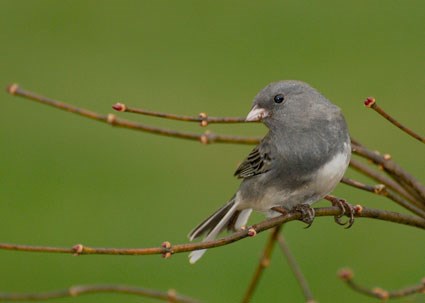
Dark-eyed Junco
“Slate-colored” Junco
- Pink bill
- Gray and white body
- White in outer tail feathers
- © maia bird, December 2008
- http://www.allaboutbirds.org/guide/dark-eyed_junco/id
There’s been a new chattering in the yard, a loud chorus, as if a whole new group of birds moved in when I wasn’t looking. That’s exactly what happened! The dark-eyed Juncos are back. The males are loud enough to be heard from several hundred feet away but I’ve found that Juncos have both a loud and a quiet song. The quiet – a series of whistles, trills, and warbles – only carries about 40 feet. I must have had a bunch of males claiming their territory.
I looked them up after pausing, on my way out to the cabin this afternoon, to see who was making all the racket. It didn’t take long to spot the Juncos. As I walked, they flitted up out of the leaves, their white tail feathers flashing. From the website above, I found that they live on forest floors of the western mountains and Canada but flood North America for winter. I knew they were Juncos right away, but went on-line to see if I could find a site with a recording of their song (this one has it). There were other birds in the yard, and I wanted to know which were doing all the singing. As soon as I heard the recording it was obvious that the Juncos were the source.
When I heard the new birds, I thought right away about the season change. I always figure the birds know more than we do about the coming of weather. Maybe the newspaper will be reporting cooler temperatures tomorrow.
My dad used to say that if you passed cows lying down in a field, there was a storm coming. I love the kinds of “news” you pick up through observation.
I’m just coming out of one of those periods of feeling “off” and I’m finding that the signals from nature are a lot less complicated than the ones from human beings. With human beings lately, I’ve been second-guessing what I observe, which means, more or less, that I’m second-guessing myself; second-guessing my impressions, my intuition, my way of knowing and being.
Could it be like a seasonal change and nothing to get alarmed about? The coming of those things, those changes, that will be what they will be but nonetheless effect us, like the weather and the storm do the Juncos and the cows?
With interrelatedness, this confusion is so mortifyingly human. There are times you don’t know when to lie down and when to sing loudly. Sometimes it’s the pits and makes me wish that I had no mechanism in me through which what is natural could be turned off like water from a spigot. I wish that, like a bird, or a cow, there was nothing in me other than an indisputable instinct to migrate, or to get my feet under me in a storm.
And then of course, in another day, when the doubting mood has left me, I’m awfully glad to be as I am, doubt and all.
It’s said in the course that all fear is doubt about yourself. I’ve never gotten much of a “charge” out of the word fear and for whatever reason haven’t felt myself to be a fearful person. But doubt carries a real charge and I can see what is meant. When I’m in one of my doubtful moods, even if I don’t feel fearful, I am more or less paralyzed. I don’t feel comfortable enough to be myself and that’s when I fall away from trusting and feel lost in confusion.
Still and all, confusion has been a good friend to me. It causes me to question myself, and I am, if not comfortable with it, accepting of the discomfort (even when I bitch and whine about it).
Margaret Wheatly spoke of this years ago in her book “Turning to one another: simple conversations to restore hope to the future.” I remember reading this sentence with surprise at its truth: “As we work together to restore hope to the future, we need to include a new and strange ally – our willingness to be disturbed.” I recall how I thought People no longer want to be disturbed. I didn’t think it applied to me, of course…but it does!
I’ve always thought:
Would change ever come to us without questioning? Would we ever make course corrections without questioning, confusion, doubt?
Now I’m getting psyched at this new idea of separating the dreaded doubt from the challenges of change, and the willingness to be disturbed. It’s such an easy to miss distinction that I haven’t seen it…haven’t seen that I don’t need to doubt myself in order to let in new insights or navigate transitions. What a revelation!
What a season change!
