Mari’s Blog

What is in your heart can be retained


Your return to union is your return to love and it is accessed at the center or heart of your Self. Your mind was in need of silencing in order for you to hear the wisdom of your heart and begin your return. Now, in order to complete your return, mind and heart must work as one. T1:17
These are the two photos I took from the airplane as I arrived in New York.
Now I am home.
Luckily, I came in on Sunday afternoon and the Sunday newspaper was sitting on the kitchen table. I needed the normalizing of “coming back.” In the book section there was an article written by Mary Ann Grossmann about Afghan women writing poetry. Farzana Marie collected the poetry and spoke at an event for the collection’s publication. She said, “A vital, powerful stream of poetry runs through (Afghan) culture because if it is in your heart, it can be retained even when everything around you is destroyed.” That sentence, and the entire article, spoke to me deeply. I set it aside to carry out to the cabin with me, thinking that it might inspire this very post I’m now writing.
It is part of my settling process, to ponder what has been in light of its deeper meaning. The womens’ voices spoke to me on many levels. One was in identifying with their realization that their poetry was worth the risk, even of death; it was that essential to them to express what was in their hearts. The other was more related to what is destroyed, to what it takes to leave an old life, an old era, a former time. In the in between, we hold the tension of old and new ways.
Farzana Marie said “Poetry is central to people’s lives in Afghanistan. Poetry thousands of years old is on people’s tongues and minds.” We, too, hold bits of poetry within us, some of it literal poetry, some of it the tone of wisdom words that touch our hearts.
(“Load Poems Like Guns: Women’s Poetry from Herat, Afghanistan,” Farzana Marie, Holy Cow! Press)
The most amazing thing that happened in New York, for me, was the touching of each other. Some of this occurred in words, but much of it was in actual touch. I have never received so many hugs. So many people came to meet me with their hearts wide open, needing to tell me about the affect A Course of Love was having in their lives. Each one was so sincerely heartfelt. And as the weekend progressed, there was what felt like a slow melting of the heart that touched nearly every attendee. This melting caused a blurring of the remaining edges, the division between the words of love expressed in A Course in Miracles, and the words of love expressed in A Course of Love. By the end of the conference, I could feel a sense of unity. It was almost as if we’d come through something together. The magnificence of the event was that we stood within it. It affected us.
We can often make light of our lives and fail to see the significance of the times we pass though, but I do not want to do that this time. I felt such a sense of the impending as I left on this trip, and feel such a sense of the passing since I’ve returned. This feeling relates to these Courses but not only to them. It is a sweeping sort of feeling, a sense, an aspiration for new life. There, in New York, no matter what conflicts or issues we brought with us, there was a sense of certainty in our ability to move beyond them. It was coming from the same central place that keeps poetry essential in a ravaged country: the heart. “The heart is the center of your being.” It was a recognition of what is there in us that seeks only love and that in finding love, unity is regained.

Outward Manifestation
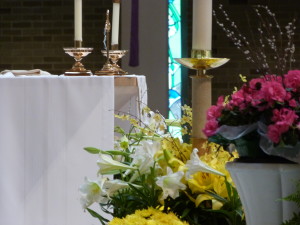
 When you let go of fear and invite unity to return, you but send out an invitation to love and say you are welcome here. What is a dinner party where love is not? It is merely a social obligation. But a dinner party where love is welcomed to take its place becomes a celebration. Your table becomes an altar to the Lord and grace is upon it and the Lord is with you. C:11.18
My grandson Henry made his First Communion yesterday. The priest (one of the four priests) who officiated the event, spoke of his own First Communion, saying, “I don’t remember much about my second grade year, but I’ll never forget my First Communion.” For almost everyone I know, hearing of Henry’s First Communion brought up the distant memory of their own First Communion. Getting Henry’s hair cut for the event, the barber and I had an extensive conversation about our memories. People with whom I’ve emailed for years, yet whose past religious experience I knew nothing about, have also been moved to recollect this moment of their past.
The timing of this family event, as has been the way with the timing of most every event in my life the last year or so, touches me at both a personal and a symbolic level. A sacrament is an outward manifestation of an inner reality. The inner reality that is manifested visually by Communion, is having a place at the table.
Tomorrow I will begin the travels that will take me to the annual Course in Miracles conference. It struck me this morning that this, too, is an outward manifestation of being invited to the table.
When I was within my love affair with ACIM, I doubt that I would have had a bit of interest in another course. In sheer size alone, I can’t see myself as welcoming one. ACIM was such an intense read that it knocked out any desire to read anything else for two years. I know that for some, this feeling lasts decades. In this way, I have been able to relate easily to ACIM readers who haven’t been drawn to A Course of Love. In fact, I am always in awe at the ways people have “stumbled upon,” been surprised by, or been “taken” (almost against their will) into the depths of A Course of Love. That this has happened is, in some ways, the cause of this “invitation to the ACIM table,” one that says, “You are welcome here.”
In another way, an inner and invisible way, the invitation of Communion is to welcome a guest “inside.” The little ones are told, “Welcome Jesus to dwell within you.” This too is implicit in the invitation of both of these courses.
The startling message of A Course of Love, the one that challenges and yet propels many of us, is the call to outward representation of a true inner reality; a true self. And so I go off, with some lovely friends and colleagues, to represent A Course of Love. I’m so appreciative of the invite, and of the companionship I’ve been offered along the way. Thank you. And if you should remember me this week, please join with me and all of those contributing to this Feast. Because we are all welcomed to have a place at the table . . . as who we are in truth.
Now the ego has been separated from the personal self so that you may claim your personal self again and present to others a true representation of who you are. … A true representation of the Self that you are is what we work toward in this Treatise and will lead to true vision and to a new world. … A representation of the truth not only reveals the truth but becomes the truth. T3:1.1-4
Liberation Stories
 Our liberation story may seem specific to our historical experience, but its message–that we are not stuck, that the world can be totally transformed, healed, repaired, and that the forces of oppression which seem so overwhelming at the moment can be overcome–is universal and as needed in April 2015 as it was in April 1250 B.C.E.
From Rabbi Michael Lerner of Tikkun Magazine
What is our liberation story today? What is our personal liberation story, and what is our collective liberation story? Our personal liberation stories can seem so mundane that they’re hard to recognize. A reflection on mine began at Walgreen’s.
It was Wednesday. My grandson Henry had a playdate with Fernando, a boy from his class at school. Henry switched schools this year and I’ve been trying to facilitate friendships with his classmates since September. His two best friends at school are Mexican boys. Fernando speaks English as a second language. I had sent several notes with Henry asking if Fernando could come play, but had gotten no response. Finally I managed to get a phone number and the date was arranged for this mid-week day of their spring break. Then it was canceled. Because it was canceled, Henry stayed on at his mom’s.
Suddenly, there was nothing I wanted to do. I had much to do, but there wasn’t one thing that held any appeal at all. I wandered around the house telling myself “You could do this, you could do that,” ticking off the possible items for attention one after another. After some time, I concluded that I would go out and get something to fill the Easter baskets of my grandsons. I did not feel like doing it, but I didn’t feel like doing anything else either, and I was too restless to … rest.
So I stood in the aisle at Walgreen’s. I stood there so long that a clerk came up and asked if she could help me find something. I said, “No, I’m just not in the mood to do this today.” She walked away. A little later another clerk came and asked me the same question. I told him the same thing. I thought of leaving, but then I told myself, “If you do, you’ll just have to come back.” So eventually I began to pick items off the shelf, thinking as I did, that last year, I was on top of my game. Yep, last year, I was. Henry and I were re-reading an Easter book. “Owen and His Marshmallow Chick.” The book spoke of everything Owen got in his basket, and that’s what I went out to buy. One of Owen’s items was gumdrops. Another was buttercream eggs. I went to a fine candy store for these items. And of course there were marshmallow chicks, otherwise known as Peeps. Now it was only days until Easter, and I was standing in the generic aisles of Walgreen’s, shopping just to fill a basket because that is what I do. What is expected of me. What I expect of myself. I thought, “I’m going to announce that this is the last time. No baskets next year.” But I don’t know if I will. Maybe. That’s all I can say … today.
And this is part of my liberation story.
The week continued on in just this way, as if everywhere I looked, I was being called to change my story. It is not a comfortable feeling. It is a challenging feeling. I mean no disrespect by starting with the quote from Rabbi Lerner and talking about Easter baskets. I realize that they do not fit in the same category. The call to liberation begins large. It’s a sweeping feeling where change on a grand scale is fervently desired. Then it begins to move down into the everyday.
And that is the way of this Course.
Threads

This is the piece that screams never to that which would beat you down. … It is the cry that says, “I will not sell my soul.” … This piece is held within your heart, and it is this piece with which we now will work. C:7.5-6
One of my greatest joys in life is following the threads that seem to begin to weave themselves together on their own. They arise everywhere, like ghostly specters, the unseen come to taunt and tease forth. I love being in their grip, the beginning being particularly delightful. It’s an exploration. I’m on the scent. Whee! Joy!
This week it has been “soul” that has called. It started with a few lines in A Course of Love appealing to the part of ourselves we knew to cherish and set aside from the harsh realities of the world. The urge was vague though; not defining itself as “soul” until after I found myself looking for a favorite James Hillman book: The Soul’s Code. The first day that I went looking for it, I didn’t find it, and it wasn’t the kind of urge that made it necessary to do so.
The best thing about threads is that they meander.
The Soul’s Code was not in the house but in the cabin and I retrieved it a few days later. By then I recognized the urge to find it as the beginning of a thread, an initial clue that I would follow. I became quite happy, even excited about seeing where it would lead, and sure enough, as always happens, following a thread reveals the old adage that it is not the end but the journey that reveals.
There are so many textures to an exploration of soul that they can’t be counted. Yet, as I began  The Soul’s Code, I found myself thrilled by realizing why it was this book, from among many that I have on the subject of soul, that was the only one I sought to find. . . .
Last week I wrote on my upcoming journey to New York. I’ve had various responses to it. My daughter Mia came over and asked if we could sit out in the cabin and talk. She mentioned having read it. She said, “I thought, ‘Oh shit, she’s saying, “Goodbye. I’m out of here!”’ A friend made a comment that he thought my expectations were too great. I could see why each of them felt as they did. But my reverie on the trip wasn’t about farewell or high expectations. New York represents a big ol’ thread, maybe the start of a whole new ball of yarn, maybe the wrapping up of many diverse threads. And that is why, or the major reason that I believe I was drawn to The Soul’s Code.
What Hillman is doing in this book (he’s a renowned psychologist) is hoping to return soul to the field of psychology. He says that he wants to set psychology back two hundred years to the time when Romantic enthusiasm was breaking up the Age of Reason. On the same page he says, “We need a fresh way of looking at the importance of our lives.” And a page later, “To change how we see things takes falling in love.”
 A Course of Love has a similar method. It begins to break us from our own age of reason, to encourage us to value our lives here, and to make us fall in love so that we see all things newly.
Rejoice that there is something in this world that you will not bargain with, something you hold sacrosanct. This is your Self. Yet this Self that you hold so dear that you will never let it go is precisely what you must be willing to freely give away. C:7.7

Standing at the beginning . . . again

You are an immigrant coming to a New World with all your possessions in hand. But as you glimpse what was once a distant shore and now is near, you realize none of what you formerly possessed and called your treasures are needed. How silly you feel to have carted them from one place to the next. What a waste of time and energy to have been slowed down by such a heavy burden. What a relief to realize that you need carry it no more. How you wish you would have believed they were not needed when you began. How happy you are to leave them behind. C:1.7
A Course of Love was, from the start, a vocation. I wanted it. I wanted the work. I’d been looking for a new “job”—for work—work for God.
This compunction was evidently a needed component to me being the scribe, and I’m using that word purposefully here, because, as first receiver, I was also the scribe, the one writing down the holy words. This love of actively being engaged, particularly with the written word—fit me.
I fell into this vocation wanting it to enclose me; to give me a new life where I would be held and supported by the work I loved. When you desire a vocation you want a container, a structure, a routine, a little recognition, an engagement, a paycheck. “I” wanted those things. In many ways I needed those things—felt I needed them, at times, rather desperately. But they didn’t come. My support came from my husband and he was, at times, over-extended.
Nearly ten years later, and just before the recession hit, my dad died and two weeks later my grandson was born. These events greatly changed the shape of my next years. I cared for my dad while he was dying and then my grandson, who lived with us, and for my mother-in-law, during the two years before her death. Eventually, I came to feel rather tired in my caregiver role. Yes, it was one way of giving love and care, but I was weary.
All throughout this time I’d been writing and had published two books. Now I began to work on another: “Discovering Feminism.” I felt a new, radical side of myself emerging and I was surprised to find it felt truly consistent with A Course of Love. It wasn’t just women or the poor who needed the freedom to be who they are—it was everyone. I started being on the lookout for “truth tellers” as I began to see more clearly the deceptive practices of politics and the machinery that runs society. Within these new musings I heard ACOL’s words about ending deception—ending the illusion and creating the new—in a fresh way.
With these ideas in mind, I spoke at a Women and Spirituality conference that was attended by  a Course of Love reader, Glenn Hovemann. During his visit we began the discussion that led to this new publication of the Combined Volume of A Course of Love.
I don’t think it’s any accident that this occurred in the way it did. It seems also no accident that my years of caregiving in the way I have are ending (my grandson is returning to the care of his mother) at precisely the same time that I’m traveling to New York to attend the annual ACIM conference. The trip now has a symbolic sort of presence in my heart. I am fully feeling this as a time of one life ending and another beginning. That’s what this Course has been like all along, showing up in my life as the necessity of closing out the old to make way for the new (most by way of inner change, but occasionally external change as well).
 ACOL begins with an image of an immigrant going to a new land—an immigrant heavily burdened with things that will not be needed; an immigrant who can be shown a way to set those heavy burdens down and truly find new life. In setting my vocation aside, I found it. It is not “about” being a scribe, or feminism, or politics, or even abandoning care-giving entirely. It’s not about anything at all, and it’s about everything. It’s no smaller than the love and truth offered in A Course of Love. And no bigger than being true to myself. All of my life experience is gathered together by it.
I won’t be speaking at the conference, which feels like a great blessing. I am able to go and dip my toes into the waters, into the flow of new life. I feel that I stand at the beginning . . . again. But I do not stand alone. This is what is truly new: the growth of friendships, colleagues and community, and of readers as in love with A Course of Love as me.
We are not alone. Our way is opening. Our time is now.
