
Mari’s Blog

It is a new time
 Your learning must take on a new focus. Be like the little children, and inhale the world around you in order to make it part of your Self. C:30.3
In October, the first teacher conferences of the year are scheduled. Students have a few days off and it always seems way too early to me, as if, just when the kids are getting settled into the routine, there’s a break in routine. Personally, I love routine. I believe the whole idea behind the common routine of monks is that they don’t think. They don’t think about what they’ll do that day, what they’ll wear, what they’ll eat. Ever since A Course of Love came to me, I have felt a desire (as many of us do) for a life I don’t have to think about, a life where I can simply be. And so over the years I’ve moved through various stages of acceptance of those things that keep me in “thinking” mode, and of ability to notice where I’d feel release from it. What I’ve found, is that when I’ve had a sort of “natural order” to my days, a feeling of simply being will come over me spontaneously and get established in me without effort . . . and then become something left behind only with effort.
I bring this up in relation to the days that my grandson was off of school, because we took a little trip. A very little trip. We drove an hour to the river town of Red Wing, Minnesota, to see the sights and spend a night. The town was named after a Mdewakanton Dakota Chief and  came from his use of a dyed swan’s wing as his symbol of rank. The red wing has become a familiar symbol of the town, of Red Wing shoes and Red Wing pottery and stoneware, all of which are of high quality.
The shoes may be what originally drew my family to the town. My grandfather on my mother’s side was a shoemaker from Sicily. He opened a shoe repair shop—“down south” as we say, not long after he immigrated. His sons, my uncles, followed him into the business. When they would come north to visit my mother, we would take them to visit the Red Wing shoe factory, where their own history found them being treated quite royally. Later, as the town became more of a retail center, my sister, or girlfriends and I would visit once a year, always in the fall, to enjoy the vivid display of colors in the trees along the river. I hadn’t made the trip for many years, until last year, when I initiated this first annual family outing.
Getting back home from it, I had to adjust again…back into my routine. But what a wonderful feeling it is. Maybe some of us don’t change all that much in what we require. With my grandson living with me temporarily, I’m so aware of the consistency needed by children. You get everything set up, if you can, to provide safety and security and love. You want daily life to operate efficiently enough that all of the other matters that a child needs to attend to can happen with as little effort as possible. You leave time and space around one activity and the next so that your child doesn’t get overly tired. You pay attention to meal times and bed time. You provide a container, a holding ground, from which you send your child out to meet the world.
And when you see a child meeting the world with joy! Henry and his cousin spent an hour of our first afternoon in Red Wing catching (or better said, chasing) leaves—brightly golden, twirling, sparkling, leaves. It was magnificent.
The Sunday following this little trip, after meandering back into a “routine” Sunday morning, I prepared to make a meal that I make mainly at this time of year. A crock pot meal. Then, thinking of a radio show I’m going to be doing on November 6, I thought I’d listen to archived programs as I chopped carrots and whatnot. Continuing in this leisurely way, I went onto my email to get the url for the show,
Its All About Relationships with Edie Weinstein | VividLife.me
and noticed an attachment I’d failed to see before, asking me for a good deal of information. The date on it was September 15. This caused a big “Yikes!” as I pride myself on meeting deadlines and things of that sort.
And so I began to scramble.
At the end of my day, when I wondered why I was so tired, it only took me a minute to put it together. It wasn’t the crock pot meal. It was that rush that came with the Yikes! The desire to correct it immediately! Calling two friends to help me figure out how to create and send a 600 X 600 photo. (Thanks Mary and Terry!) Trying to collect myself to address two of the most dreaded questions—the basic bio—Who are you in 100 words or less, and What do you want to talk about. I got myself whipped up into a veritable whirlwind of energy. And then I crashed.
I found myself writing this in my journal Monday morning: I think this may end up being an exceptionally boring year in terms of personal growth. I wrote that because I feel as if this is the year that it comes down, way down, into the practical. There seems to be no more fooling around space. My body, soul, and psyche, as well as my heart, are telling me, No more with all the nonsense things I get into. No, you are not to scramble anymore. Nothing is that big of a deal.
These aren’t my challenges any longer. I’ve moved into a new time of life where deadlines simply may not rule me. There are bigger fish to fry, as my friend Mary likes to say. And whatever they are, they arise out of a different place. The foundation has been set. I’m no longer building it up, no longer looking to follow an external structure’s rules or beliefs, no longer trying to get somewhere. It’s a new time. And I know that what comes next will arise—not out of the scrambling that is often such a big part of an achieving time of life—but out of the quiet and the puttering and the catching of leaves and light.
In truth
Sharing is the means through which the holy relationship you have with everything is revealed in truth. This truth lies within everything that exists, as it lies within you. As you learn that who you are is love, no deception is possible, and you can only be who you are in truth. C:31.23

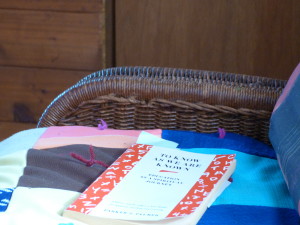
This is what happens with me: I get a sudden yen to re-read, or sometimes just to re-find a passage of a book that meant a lot to me. That’s what happened a few days ago when I took To Know As We Are Known off the shelf. It is, I believe, the first book Parker Palmer ever published, and it is my favorite of his. The copyright is 1983.
Sometimes I feel as if I could chart my trajectory since receiving ACOL by remembering my readings. I know one thing for sure. When I read To Know As We Are Known I was awed by how much of it sounded like A Course of Love.
The reason I went back to the book—this time—was the audio recording I’m doing of ACOL. But I didn’t know it as I felt the yen. I merely knew I was being drawn. I had recently recorded one of the concluding chapters of ACOL: The Nature of the Mind, and had experienced a deeply felt memory of the original receiving. That memory was of the way I heard the words in truth. They’re repeated and repeated in that chapter, and each time I heard them, I felt that I was in truth. It was the most inexplicable feeling. It was an experience of the reality of truth. Not truth as concept or statement, fact, or philosophy. I felt that truth had its own reality, its own realness, and it was right there. It was with me like a presence in the room.
I didn’t know I was seeking this book in response to that re-kindled memory until I found what I didn’t know I was looking for. It’s this passage, which is just one of many, where Parker Palmer speaks about truth in the way I felt it that day:
To know something or someone in truth is to enter troth with the known, to rejoin with new knowing what our minds have put asunder. To know in truth is to become betrothed, to engage the known with one’s whole self, an engagement one enters with attentiveness, care, and good will. To know in truth is to allow one’s self to be known as well, to be vulnerable to the challenges and changes any true relationship brings. To know in truth is to enter into the life of that which we know and to allow it to enter into ours.
The way Parker describes truth is, I feel, the way of this Course. Allowing these words to enter us, we know in truth, and in truth we are known.
Do not be afraid
 What has gone undercover in your life? What new fears have you developed? Why are there people asking spiritual teachers if it is okay to cry? There needs to be a way, once we are aware that the ego, false self, or idea of separation is wrong . . . to let it go and begin anew.
I like to say that with A Course of Love, you get to take your Self back, and you get to take the world back. I have noticed what I call new fears and I see no reason to leave one set of fears—ego fears—behind, only to pick up fears that might be called “human” fears. No one has to be afraid to care, or to cry. No one needs to be scared to share, afraid to admit to illness or disease, or to feel they have a purpose, a talent, or a calling. There is no need to be afraid to appear intellectual, to fear to be personal, to be frightened into silence in the company of spiritual peers. It is not arrogance to tell our story. To grieve is not a failure. To have troubles, to admit that there are things that keep us up in the night, or that we may be concerned over the state of society or the planet, are not admissions of defeat. It is not conceit to feel that you have good ideas or believe that you can make a difference in one life or in many.
A Course of Love is an invitation to be fully who you are . . . in a new way.
The Heart’s Way of Knowing
 What is it that each of us commonly desire, that each of us might say we yearn for more than anything else? Isn’t it love? Might this yearning for love show up, not only in regard to feeling confident in loving relationships, but in our longing to be who we are? To have the courage to be passionate about being who we are—not just authentic and boldly able to be truth tellers, but able to be vulnerable? To be open enough to receive; expressive enough to extend; fearless enough to take risks in pursuing the lives we feel called to live? All of these desires are addressed in A Course of Love.
In our quest for love, why not start with the heart and the heart’s own wisdom? Why not start with recognizing what that is, what it looks like. Feels like. Why not begin with acknowledging desire? It’s part of the wisdom of the heart. So is receptivity. Receptivity is part of the heart’s wisdom, and is one of its ways of knowing. Receptivity allows “what comes.”
“What comes” is very much a matter of feeling—recognizing a feeling. I spoke of a “whoosh” of knowing the other day and a woman said, “I’ve felt that! I’ve just never paid it much attention.” What I described as a “whoosh of knowing” was simply that: A knowing. Something known. That’s what receiving feels like. Something made known to you. When something is made known to you, it does not come attached to anything, does not feel like a result of practice or study or figuring something out. It feels like pure gift. It simply arrives.
Often a knowing is where the great mystery begins. A recent example for me was the knowing that came over me (that’s another hint—a knowing will “come over you”!) as I began the audio recording of ACOL. I knew I would not just record, but that I would “receive” the Course again as I did the recording, and I knew I was to do it in forty days. Now you might think this would mean it would go really smoothly and the purpose would be the recordings themselves. The work has gone okay (not miraculously well) and the eventual audio book will, I’m sure, be a helpful one. But the sense of the knowing is that there is another reason. Another reason for “receiving” the Course again in this way, and another reason for the forty days, and that both are deeply personal to me. I was given this knowing for a reason that has a mystery behind it and is yet to be revealed.
This knowing does not arrive feeling as if it came from me. It feels like it came from a Source beyond me. But I have received it and am in relationship with it. This is the way of the heart’s knowing. It happens in relationship! Our own knowing is what Jesus wants us to realize and pay attention to. He speaks of the privacy of the heart, of love inviolate. He says no one else’s answer is yours. Claim it, he says. Claim your own knowing.* Your answer is your own and it’s available in your own heart. Why in your heart? Because your heart is your place of connection.
A deep, heartfelt connection—to a friend, to nature, to Jesus, to Great Spirit, to a creative endeavor, to an idea that arises—any deep connection is divine and capable of inspiring revelation. It’s nothing fancy. And yet if you’re looking for something more stunning or explicit, you can miss what you already know, what is already there . . . in your own heart.
(See A Course of Love, Chapter 29. I love this: You claim not to own or to separate what you have from what another has and then to call it special. You claim in order to reclaim your Self.” C:29.22)
The new freedoms
 From here your life becomes imaginal, a dream that requires you not to leave your home, your place of safety and of rest. C:20.10
I am in the cabin. It is late by my ordinary standards but it is still dark, and it feels more dark because I am alone. No one is in the house. No one is on their way here. No one is coming later. No one is spending the night. No one will be here when I get up in the morning. I have a day. More than 24 hours. Possibly a time span greater than 48 hours. My husband has gone hunting. Once or twice a year this happens where I get not just time, but the whole house, to myself. I’m guessing most women secretly love it. A few have told me so. The most recent one got a wild look in her eyes and did a little dance. Me? I’ve been taking it a little easier lately. I had no big work plans. But still I wondered: Will I make something of it? Will I hunker down and make a start at something? I cannot decide, and yet I will. I will start something just by being here, and I know it. My plotting, my fantasizing in life, is how to get here, not what to do once I’m here. The “what to do” takes care of itself. I think this is because I love being alone.
Do you realize that many people don’t? I read an article from the Washington Post a few months ago that noted a study appearing in Science that showed a quarter of women and two thirds of men would rather have electric shock than spend time with themselves.
I can’t claim to understand people who don’t like time alone, but I do know a few. Our different ways of experiencing ourselves and life makes us fascinating and often complimentary to each other. Yet it’s only fair that I share my love of quiet because I know it affects how I see and feel what is there in A Course of Love. I see it, you might say, my way, with my nature (as each of us do). I find the words that feed my desire for solitary reflection, words that speak of dwelling and devotion, of memory and prayer, imagination and ideas, but especially that of experience, a word that pretty much encompasses all of it. When embracing the inner life spiritually, we are guided to the “center of ourselves” which is decidedly not a point just above the belly button. That “center,” like my “soul” is something I have to imagine. I cannot see love, but I can experience it. Imagination and experience—two feeling states that call us to awareness. I can only say that for myself, it is when I feel somewhat liberated from my busy life, somewhat liberated from the culture, that I feel that I am ready for the new. Don’t know what that’s going to be but I’m here and present and open to it.
In my audio receiving/reading, I have now recorded past Chapter 20, which is my favorite and the loveliest of the Course, but which I’ll have to return to since I was trying so hard to make it a particularly lovely reading, that it became the worst one I did! (Could this be the biggest message of this Course? Quit with the effort, the earnest trying to do it right?) It is amazing to me that it is as clear in audio as it is writing: Trying hard just reaches right in and zaps all the naturalness out of us and the energy out of whatever we’re trying to do. I think even if I got it perfect it would be perfectly unnaturally and dull as an ironing board is flat. Anyway, it is in Chapter 20 that Jesus speaks of the imaginal, a mention that has intrigued me for at least two years. Before that, I had not caught the meaning of the word imaginal. Now, I have enough understanding to know that the imaginal realm is greater than imagination. It explains a lot about A Course of Love, or it does to me. It explains a feeling I continually have that what I’ve gained is more than what is “in the book,” and it gives me understanding about the way the ego simply loses power as we are affected by that more. It is as if the “method” of this Course is so astoundingly different, that we don’t realize what is happening as we innocently or avidly go about our reading.
The noted psychologist and writer James Hillman calls imaginative activity, “Both play and work, entering and being entered,” and says that “as the images gain in substance and independence the ego’s strength and autocracy tends to dissolve. …The extraordinary fact of the imagination is just that it is truly extraordinary no matter how known, it is always able to surprise, shock, horrify, or break into ravishing beauty. The distinctions we make when exploring it can never be from known vantage points; rather the experience of imagination shatters these vantage points. The best test of authenticity concerning our disciplines of exploring the imaginal is that the habitual ego senses itself at a loss ….” (Re-Visioning Psychology)
What happens to the ego? It loses its footing. And as it does, it is easier to realize that by going where it cannot tread, our feet find new freedoms.
