
Mari’s Blog

Noise and joyous noise

We have not removed ourselves from life in any way, and yet we have reached a place of retreat, a place of safety and of rest, a place away from “normal” life and the lack of freedom you have experienced there. I am your refuge from the past, your gate of entry to the present. You have fled the foreign land, where freedom was merely an illusion, and arrived at the
Promised Land, the land of our inheritance. D:Day9.1
Creating an audio book is such a solitary activity. The other day, as I was re-recording some earlier chapters, I had this thought:
I’ve gotten so much better at silencing the noise around the words.
It was a thought about a technical aspect of working with the audio, but it didn’t stop there. It kept coming back around. It reminded me of a conversation I’d had with my daughter a month before in which I talked of needing a quieter life. She asked, “How could your life get any more quiet?” In terms of lack of noise, my days have been quieter than ever. I couldn’t answer Mia right away but later I did, telling her that “noise” was about more than actual sound or commotion or activity. It is about being aware of expectations, about needing to be aware of other people’s schedules, about things undone, or unspoken. I spoke of the noise of the unresolved of former situations and the pending of new ones; of hopes and questions about the future. All those things that, even when you’re not thinking about them, still exist within you, and even though they can at times reside there quietly, can, at other times, (particularly times of manifestation) live in you as another kind of noise: What’s the “best” way to . . . go forward? (with this, that, or the other thing). “Silencing the noise around the words” sounded so appropriate to all of the words, thoughts and images that were in me. It wasn’t about getting rid of the substance of them, but the “noise” around them.
Yet, while I know what I mean about the lack of noise for having experienced the grace of solitude, that’s not always possible or even desirable. There is joyful noise too.

Mari & Rose
I’ve had an active week, finishing out the audio of A Course of Love, visiting with Rose Gannon, a new Course of Love reader and friend, and putting some final touches on the Dialogue video series that will be launching soon on the Center for A Course of Love website.
Creating and feeling the creation as it happens, in a dialogue between companions, carries a feeling no more wonderful really—but vastly different in feeling—from the writing I more commonly do, and the audio I’ve been uncommonly occupied with. The feeling is one I often describe as overwhelming but that is also fascinating, emotional, enlightening, thrilling, exhausting, and splendid. It holds the energy of creation and is full of the unexpected. “Something” happens. There is a stimulation that causes something new to come to be and that can cause as well, the sense of overwhelm and the exhaustion that comes after. Rose literally trembled with it. Mary Love, who joined us for the video work, added an element of tenderness, tears, and laughter.
 Additionally, being as Rose and I are both Catholic, she and her friends Matt and Mary joined Mom and I for our usual Saturday night Mass. As the first hymn began, and I heard and sang its words, I leaned back, as I was a person removed from Rose, and at the same time, she leaned back, so that our eyes met around the person in between us. I think it started with the first stanza but then happened a second time when the next stanza began:
“We are learners, we are teachers; We are pilgrims on the way. We are seekers; we are givers; We are vessels made of clay. By our gentle loving actions, We would show that Christ is light. In a humble, listening Spirit, We would live to God’s delight.”
It was such a sweet moment! There we were, in church, with its usual ritual and prayers, hearing something that was in “our language” . . . the language of ACOL and of our time together . . . and at the same time in total sync, knowing and sharing our recognition, our awareness of it.
The funny thing is, is that, we—in relationship—are the ones being revealed. Our responses reveal to us who we are. We can become aware of a relationship to a person, a hymn, a feeling, and to thoughts, expectations, pregnant pauses. I can accept the responses that arise, whether they are feelings of “noise” I’d rather get away from, the noise of the cacophony of State Fair sights and sounds I encountered with my family today, the blur of energetic noise in creativity, the hum of overwhelm, or the tone that is the canticle of joy (E.25).
Response reveals the truth to you because it reveals the truth of you. T1:4.19
The more I read and review A Course of Love, the more I’ve come to feel that there’s a constant recycling, or making new, that comes quite literally out of the old. Right away a movement begins that takes us all the way through to the ego-less self. But then it is as if it sends us back (not to ego but into life, or from level ground, to mountain top, and back again) to pick up our discards and to make them new. Done with the way things used to be, but continually not done with the discovery of what can be.
Laugh. Cry. Shout or wail. Dance and sing. Spin a new web. The web of freedom. D:Day9.2
Words of the hymn are from, “As a Fire Is Meant for Burning.”

Service to God and being “used”
 You who have so worried over what to do have both welcomed and feared the idea of some kind of service being required of you. . . . To be of service to God is not to be a slave to God but to attend to God. To give God your attention and your care. C: 29.3
I’ve been working diligently on finishing up the audio of ACOL the last week or so. I’ve been at it for the always appropriate nine months, but now I’m on the home stretch. Just a couple of chapters to go, and seeing the end in sight, looking forward to having it done in the next few days. The “end of summer” that August is has been heightened. Later this week I have a friend visiting from out-of-town and the annual family excursion to the Minnesota State Fair. The pressure, you might say, is on.
I have a love/hate affair going with pressure, as most of us likely do. I don’t know if this pressure is better or worse when it is self-imposed. My publisher is a “better sooner than later,” but basically no pressure kind of guy. My pressure comes from within and there are things that happen that make the timing seem right.
This week was exactly this way. You want a reason why you’re feeling the way you do? Well, when you do, often enough, the universe responds. Here it is.
So let me back up. I’ve had a notion for some time of “telling my story” with ACOL, but I wanted to find some writing I knew was around somewhere, that would give me the “actuals.” What was I “really” feeling then…not the “this is how I remember it” kind of thing. This week I found some of my writing from 1998.
I’m working on Chapter 29 or about to, as I find this writing. The date of it is November 5, 1998. I’d been off of work for nearly nine months, awaiting the “work for God” that I felt had been promised me in a dream and emphasized again and again in feelings the strength of which were driving me a little crazy. My family’s finances were horrible and I felt I had to return to work, something that absolutely couldn’t be avoided a minute longer if I was going to be just sitting around waiting. This is what I wrote in my journal of the time:
Please do not leave me here much longer. Help me feel inspired. Help me to feel as if I’m doing what you want me to do. Let me know what you want me to do. Guide me into the world or give me confidence and joy with which to find fulfillment in this small one I’m so loathe to leave. I feel as if I’ve come to this point—so that I’m ready to follow. I DON’T KNOW WHAT TO DO. MY PLANS AREN’T WORKING. MY WAY IS NOT SO FANTASTIC. I need something now and I know it. I don’t want to give up my quiet and my freedom and my days alone, but I know I need something besides this. I’ve read all these stories about people who said, “God, my life is in your hands. Do with me what you will. Show me the way.” And how their lives immediately changed. Have I not been saying this? Or saying it and not meaning it? If so, I mean it now. I’m “down on my knees.” MY LIFE IS YOURS. PLEASE USE IT. THIS IS WHAT I AM ASKING AND BEGGING. TO BE USED. IT’S TIME FOR ME TO QUIT LOOKING FOR THE USE TO WHICH TO PUT ALL THE THINGS I’VE BEEN GIVEN AND IT’S TIME FOR ME TO BE USED. I CAN’T STAND NOT BEING USED ANYMORE. I MAY NOT KNOW HOW TO GIVE IT, BUT I KNOW I HAVE A LOT TO GIVE. JUST SHOW ME THE WAY LORD. JUST SHOW ME YOUR WAY. THIS IS MY ONE GOAL, MY ONE HOPE—THAT YOU WILL USE ME. I KNOW NOW THIS IS THE ONLY WAY I WILL BE FILLED. THE ONLY WAY I CAN FULFILL YOUR PLAN FOR ME, FILL THE SPACE YOU HAVE OPENED FOR ME HERE ON EARTH IN WHICH TO BE WHO I AM AND DO WHAT I’M MEANT TO DO. JUST USE ME, LORD. PLEASE USE ME. CHOOSE ME. THANK YOU. PLEASE ANSWER THIS PRAYER.
Just about three weeks later, on December 1, 1998, A Course of Love began to come to me.
When I first read that paragraph, I thought asking to be “used” sounded like such “old” language. I was surprised by it, and it gave me pause, even while I thanked God for it. For finding it. I never would have “remembered” asking to be “used” and it felt so poignant as I read it. But then I found this in Chapter 29 (another passage of ACOL I’d forgotten):
You who would cry, God make use of me, only need to give to God your devotion and your willingness to serve instead of use. C:29.3
This whole Chapter has that feel of “old” language. Who does speak of service to God these days? Who thinks in terms of giving God our attention and our care? What could God possibly need . . . or need of us? You and me? A little further on in Chapter 29, this question is answered:
 Your gifts, your talents, your uniqueness, are your service. Can you not look at them thus? And can you not come to understand the reciprocal nature of giftedness? That what God has given only needs to be received? That what you have received only needs to be given? The indivisibleness of God is simply this: an unbroken chain of giving and receiving. Thus is this a definition of unity as well. C:29.25

The heart’s path
 The mind goes from the small to the large, the heart from the large to the small. Only the wholehearted see the connection of all. C:23.12
It’s 5:52 in the cabin. The sun’s imminent rising is visible as a streak of light-infused coral. The frogs or crickets hum in their chirpy way. 5:55 I sit up. Look out again. There’s a fiery quality beginning to build. At 6:02 the sky has faded into cloudy, cotton ball forms in baby blues and pinks. What can happen in ten minutes!
There are things that have arisen in me as sweetnesses of the heart lately. The latest was the Door’s song that goes like this: Hello. I love you. Won’t you tell me your name? These lyrics were running through my mind this morning when I suddenly realized they were like the perfect greeting for God.
The first was perhaps my new love affair with my percolator. It’s an old thing, given me by daughter Angela, purchased in a second- hand store, or perhaps at a garage sale. It’s been a constant in the cabin for a while now, but some months ago, one prong of the cord broke off in the outlet. I thought I could get by without the old girl, but truth be told, nothing I tried to have hot coffee in the cabin worked. So I finally examined the pot for information so that I could order a new cord. Although I’d been using it for years, and knew it was a Farberware pot, I had not known it was the “Superfast” model. Since ordering and receiving my new cord, I have noticed how fast it is, and just adore hearing its perking once again, and the always hot coffee it provides. I felt so grateful for it, but the tempo of my gratefulness felt sweet. Thus it began.
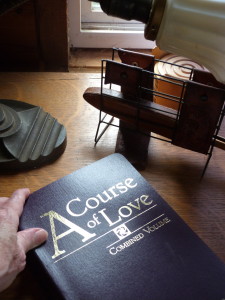
 The next in this series of sweetnesses came from a long-time reader of ACOL, my friend in Canada, Roger. He noticed my lamp in the photo I began to use to show A Course of Love early in July. I first posted it in a blog in which I spoke of another friend—Ivor’s—passing. It was
  as though suddenly, the “stock” photo of A Course of Love was not appropriate. Everything in me was too tender to include an impersonal image.
Roger responded with his photo of his lamp and his (blue book) copy of A Course of Love. Thus began our conversation, but one that wasn’t only about the lamp, although I loved it having begun in that way. It felt like a sweetness that Roger noticed the lamp in my photo and was moved to share his. In response, I handled my lamp in a way I hadn’t in years. Turning it over, I found a patent number and shared this with Roger, along with the rather unfortunate news that this was not an heirloom with an interesting history. I’d bought it at an antique store. Roger, in turn, shared that his lamp bore the name “Eagle,” and that it did have a history. It belonged to his father, a lamp he remembered from his young boyhood, and decided to keep when the family home was sold. Until seeing my photo, he’d never seen another like it and said it was even more funny that it was used to light up our same readings. He signed off with, Cheers from Boisbriand, and I fell in love with the sound of Boisbriand, the muted and romantic image of his book and lamp, of the “lighting up” of our shared readings, and Roger himself. When I asked if I could share his photo he replied:
To share freely all we have received, is the Principle that rule the Life, and mine too.
 Then I heard from another friend and reader of ACOL, Ben, who was “stopped” in that awe-struck way by Day 39 of The Dialogues and made a representation of a passage of it that he calls “The Bridge.” I couldn’t download it, but I took a screen image just to be able to share and emphasize the joy I felt in receiving it; in receiving a “creation” made of such a moment of impact.
The third “sweetness” came of noticing the shape of my grandson’s arms when I reviewed photos from our excursion to an animal farm. Suddenly, in these photos, (despite his skinniness) I could see the arms of a “man” beginning to develop.
The heart goes from the large to the small.
I’m in awe of the tenderizing of the heart that goes on as this movement from the large to the small takes place. The large is perhaps our grand awakening to all that we are. The small is the daily ways we encounter those things that touch our hearts. I need not discard these things as “small” (as in trivial or unimportant or sentimental), and surely not as a backwards movement. It is the way of the heart. Part of the movement to sanctifying all of life. Each of us can invite the “small” and hold it gently. It is cradling a wounded bird (as happened this morning as one slammed herself into my window), and it is the sun’s rising. It is what can happen in ten minutes. Another movement along the heart’s path.
The awe of Day 39 of The Dialogues, the splendor of the sun and of young arms forming muscle, of the pleasure of a percolator and a lamp, are the sharing of the small and the large that join on the path of the heart. It is revelation of the immense Heart holding it all, including all the sweetness of our own human hearts, that join us together in wholeheartedness.
Active Acceptance
 Active acceptance is what allows the great transformation from life as you have known it, to death of that old life, to rebirth of new life. By clinging to some of the old, you prevent its death and you prevent the rebirth of the new. You prevent the very life-giving resurrection you await. You prevent the elevation of the self of form. This does not have to be. D:Day3.60-61.
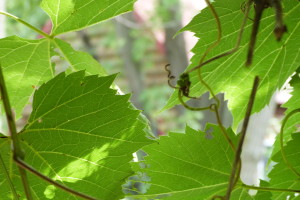
August is more than the in between month on the calendar. In Minnesota, at least, it is the jungle-like time, the claustrophobic and close-feeling time of heavy air and equally heavy foliage all around. The trellis grapevine between house and cabin hangs low with weight, the part of the grapevine that spreads along the fence does so in a middlin’ way, never quite achieving its former height. It is weighed down with itself.
Sometimes I feel that way too. That’s when there’s that need of a move from “acceptance” to “active acceptance.”
For two weeks it’s been hot and humid but the wind has kept it from being unbearable. Today, the wind is still, the movement has stopped. To walk out the door and not have any sort of coolness, to meet this heavy, wet, still and dark presence of a day beginning to come awake, may have started me on missing the wind and the movement of “active acceptance.”
 I have spent mornings in the cabin for ten years now. Once, about five years ago, I felt so accepting of new life that I gave my old life a burial. Somewhere, a few feet away from and beneath the ground near the cabin door, is a shallow tin that represented that burial, that feeling of death and renewal. I’m sure it’s in a journal somewhere, but without looking for it, I can’t recall what I put in the tin. I’m pretty sure there was a picture, probably one of me.
The times of active acceptance feel to be getting more and more lengthy, and to be leading to stranger and yet more ordinary realizations. The one I’ve been being with lately is the concept of “home.”
Home has been a place that is not about me alone. I have felt that home is meant to be a place of common concerns. That feeling has undergone a change. How many women or men starting out in life, or women who leave work earlier than their husbands or vice versa, feel this sense of a common concern having become a solo concern? While the family has been left behind, or while the other is off at work, leading his or her life, a life takes place “in the home” that is not particularly related to the other. It is an odd place to find yourself in. A solo concern. In a time in which unity is so desired, is there a conflict? What is the place for such a feeling on the path of unity?
Home is also about the “daily” living that occurs there—the home-based feeling of safety and structure that allows closeness with the small and seemingly inconsequential, whether it’s the putting out of birdseed or the making of a loaf of bread or a bed. There is a familiarity and a regularity that . . . allows an everyday newness that invites the creative spirit to soar.
I’m glad the word “solo” came to me to describe it, because it feels so different than “separate.” It brings up an image of each having their own song to sing. It is in home “coming” that I am able to embrace the solo, the solitary, the inner life and the intersection of the inner life with the outer.
The power of home and the power of creativity are linked. One of  my most treasured realizations with this Course is that we are here to be creators. This realization calls me to have a different sort of relationship to “home” now . . . a relationship that can leave behind “a” home’s structure to venture off into an unknown that holds a new sort of creative potential. From home base, especially an inner home base, active acceptance can cast one free of anchors and bring new vision.
With active acceptance, the time of learning ends, the time of reaction ends, a new response, and creation of the new, can begin.
You look outside the doors of your home and, whether you see suburban streets bathed in lamplight, streets that steam with garbage and crime, or cornfields growing, you say that is the real world. It is the world you go out into in order to earn your living, receive your education, find your mate. But the home in which you stand, much like your inner world, is where you live the life that makes the most sense. It is where your values are formed, your decisions are made, your safety found. This comparison is not idly drawn. Your home is within and it is real, as real as the home you have made within the world seems to be. You can say the real world is somewhere outside yourself, as you picture the real world being beyond your doors, but saying this cannot make it so. C:5.16
To look inward at the real world requires another kind of vision: the vision of your heart, the vision of love, the vision of the Christ in you. C:5.15
Accepting what is . . . in our own way
“While you think of acceptance as just another word, another concept, another trick of the mind, you will not see it as the replacement of learning, and as such as an active state, a state in which you begin to work with what is beyond learning, a state in which you are in relationship with what is beyond learning. It is in truth, a state in which you enter into an alternate reality, the reality of union—because you accept that reality. D.Day3.58
August is one of the in between months. As my daughter and her new husband, (who work in the service industry) say, it is the worst month for restaurants. There is too much going on: vacations, the State Fair, back to school. When Labor Day is over, business picks up again and is good through Christmas. I didn’t ask if August is worse than January, but that feel of the in between is in the air, contagious. There are things to do before summer is over. And it is time to prepare for a new rhythm.
Consequently we went, yesterday, to an animal park in Wisconsin, an annual outing. Being that it’s a tradition, there was great desire not to miss it, but it had been such a busy summer that it seemed about to slip away. And so, even though Mia’s family had just spent the weekend moving into their new house, we went, and it was about as perfect as perfect could be.
Yesterday morning, when I started this blog, I was feeling such appreciation for the way things have been. But today is a new day and I seem to have lost my focus. And why not?
We stand at the intersection point of the finite and the infinite in order to complete the creative act of becoming. (D:Day.6.1)
Are we ever removed from this creative act of becoming for more than five minutes? Acts that find us constantly swept into a new zone? A day of living changes a person. My time with my family is in a constant state of endings and new beginnings. I was grateful yesterday that they blend together, and I can appreciate both. I was grateful for this recognition. Today, my acceptance of this reality, after the big event of the family outing is over, turned in a new direction: to the reality of facing that my mom’s life is coming to an end.
I visited her, Friday, the day after the doctor gave her this news. She is soon to be 91 so it was not unexpected. It was not a “you have a month to live” ending, but an acknowledgment that her heart is failing and that there is nothing more that can be done to prevent it. I visited her with hope of the sweet connection that comes of facing ones reality. I approached, wondering if she would surrender to it. She has not. Facing death, as Jesus says in The Dialogues, is a process of acceptance like unto that which is experienced with our discovery of our true Self through this Course. There are stages to accepting a new reality. There is a time in between.
I trust that this is so, and yet Mom’s denial made me momentarily uncertain and wistful for a deeper connection right now, or at least, please Lord . . . soon! Yet it also helped me remember the need of accepting all the stages or states of our being, of our reality. There are stages to accepting a new reality. For some this approach of a new reality appears to be easy, but Jesus seems to suggest we will all go through the same “stages of grief” as we let our old lives go.
“Accept your anger for it is the next step in the continuum upon which we travel. When a person is dying, just as when a person is undergoing this final surrender, there are stages through which one moves. The first is denial, the second is anger.” (D:Day3.1) The next is bargaining and the final stage before acceptance, is depression. “Each stage may contain hints of the other . . . each stage is experienced and felt.” (D:Day3.52)
As I continue to feel the changes in my life in a new and enhanced way, I’m glad of this reminder of stages of acceptance. This variety of acceptance seems to me to be like the difference between memoir and statistics. It is why a memoir of war is about so much more than killing and yet causes one to abhor war much more than does a list of casualties. As with everything else, we each “accept what is” in our own way. There is no right way and the only “right time” is every day, every hour as we accept our feelings within them. There is our time—our time to participate in the creative act of becoming who we are, moment by moment, year to year, and even beyond time as we know it.
It may just be my view, but the process of accepting the physical life and the divine life as one, having them be interconnected, is why Jesus speaks of the stages of acceptance felt by the dying and spends so much time speaking of the constant acceptance needed to move into a new reality. It’s a reminder to me, anyway, that acceptance doesn’t come without feeling the feelings of all of it—the inner and the outer. I have witnessed this slow movement in myself. I am coming to acceptance of the changes in my life, in my way. And I am seeing that only “then” is there liberation from the old. I am not yet fully liberated, but I’m getting closer. The ultimate, liberating acceptance can’t be rushed, but it can be gentled by not being hard on ourselves or others as it comes.
You are not separate now from who you will be when you reach completion! You are in and within the relationship of creation in which created and creator become one. (D:Day.6.12)
