
Mari’s Blog
Here to reveal

What has happened here is that words have been put on the feelings and remembrances that you have within your minds and hearts and have been sharing in this dialogue.
Dialogues, Day 20.4
It started a week ago with a book review headline: “Lethem’s ‘Lucky Alan’ collection has heart, brains”. The reviewer quotes Lethem saying, “We’re these dreamy fools, drunk on narrative, who see the world around us in metaphorical terms.” The reviewer then says this is “True to his [Lethem’s] long-standing, genre-bending focus on how we tell our stories and what that says about who we are, as we struggle to find readers willing to share our solitude.” The last words were the clinker: readers willing to share our solitude.
Then yesterday, before church, Mom and I went to Mendota, to VFW Post 6690, my dad’s old Post and life-long good-neighbor, where its growth in size has not changed it at all, as I see Dad’s stomping grounds only when I poke my head in the door (as I did as a child) getting a view of the long, dark bar, the surface of it gleaming under the neon of Grain Belt, the smidgen of sun, the whiff of beer. We are there for the VFW’s annual Lenten garage sale, run on weekends to coincide with Friday night fish fries.
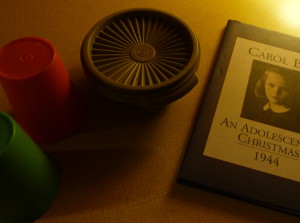
We work our way through tables of dishes and trinkets: a white pitcher with black edged images—a chicken on one side, a cow on another. Thirty dollars for an RCA phonograph on which to play your 45s, Tupperware for a quarter. I’m about to make my way out with my fifty cents worth of Tupperware; am just wandering past the jewelry, when a book catches my eye, a thin hard cover with an adolescent girl’s photograph on the cover. It is my old writing teacher Carol Bly who has haunted me more than a few times over the years. I can’t fail, despite the youthful photo, to notice that it is her, as her name is emblazoned over the picture in firm capital letters. I turn it over. It is the fourth in a series of holiday books from the Afton Historical Society Press, the first having been written by Jon Hassler. I buy it for five dollars (which tells me someone there knows a quality book) and chat with Willard, who is a cousin to my dad, as I dig my bill and change from my purse.
Then Mom and I go to church. Returning from dropping Mom off, having eaten in the church basement: a fundraising taco dinner, I bemoan having eaten all three of the tacos that came on my ten dollar plate. (Mom brought two of hers home in a to-go container.) Once in the kitchen I run the dish water and wash my green Tupperware lidded bowl, and my one red and one green child-sized cups, along with the remnants of a breakfast too small to run the water for, and then pick up Carol Bly’s book, just after drying my hands, and read it right there next to the sink. The opening:
“Tolstoy was tremendously mistaken: happy families are unlike in their happiness. I feel a glad burst writing that blasphemy—Tolstoy was tremendously mistaken—like a child making a rude sign when at last the policeman turns his back.
A lifelong task of authors is to notice and engrave the ten or twelve percent dissenting opinion about anything that counts. If Tolstoy was simply wonderful, and he was, he must still have been ten to twelve percent mistaken about something—in this case about happiness in families. Authors’ work is to honor some insights so peculiar that we are not sure it is all right even to harbor such thoughts.”
Is it possible that I have participated in revealing a long dissenting opinion, i.e., a new truth about the nature of humanity and reality itself?
With literature, I can tell in a few sentences that I am in the presence of a master. Each quickly reveals herself and cause me to want to do the same. It has nothing or little to do with having something specific to say but only with the yen to reveal. If I meander around in my own sentences long enough, this sometimes happens. And then I may be done again for a while.
I am no longer a “constant” writer, but I am still a writer.
You could almost say that I got pulled into the spiritual life kicking and screaming. As my “spiritual” revelations began, I worried incessantly over the fate of a mystery novel I’d written. As A Course of Love began I still, for a while, worried just as incessantly over the fate The Grace Trilogy, spiritual books that had recently been published. As I entered this new round of re-publishing of A Course of Love, I was in the grips of having written a manuscript I wanted to publish regarding my discovery of feminism. Spirituality seems to, despite my resistance, keep trying to supplant my first my love . . . writing. And to, in some ways, keep me yearning for the “truth” of the odd revelations of written word.
And so I eventually come to a remembrance of a peculiar item stated within A Course of Love:
The way of saying this perhaps is new, but the way of saying this is the expression of the
human being receiving it. The way in which you are hearing and responding to these truths is perhaps new, but that way too is of the human being receiving it, in this case, you. D:D20.4

I am reminded of this cycle of receiving and responding, as happened to me this week with Jonathan Lethem and Carol Bly as well as A Course of Love. I am reminded of what elicits a response and how response and expression go together. Then I wonder to what end I am being so reminded.
Perhaps I am being summoned by the responses to A Course of Love being revealed in ACOL’s new Facebook group. Each one so unique. Each expression so vital. https://www.facebook.com/groups/mariperron/
Reminded that it is all predicated on having first “received” what is given. What is “received” seems to come with a spark, a spark like that from the masters of literature that cause an aching sort of response. A need to respond. A desire to hear the responses of others. A “we’re in this thing called discovery, called coming to know, called revelation . . . together.
Here to reveal a new Self and a new reality.

Countenance
 [I]f you have been religious, abandon not your churches, for you will find within them now, direct experiences of sharing. If you have found guidance and comfort in the written word, abandon not the written word, for the written word will now elicit direct experiences of sharing. If you have enjoyed learning through gatherings of students, gather still, and experience sharing directly. If a time arrives when you no longer feel drawn to these modes of sharing, share anew in ever-wider configurations. T4:12.9
Sunday: The Cabin
According to the computer it is 6:30. If this is true (which it probably is) I’m all screwed up. Daylight savings time. At 5:00 my watch said 4:00, now my watch says twenty to five when it is twenty to six. Why does this feel so complicated? Geesh. Still, as I came out, treading the cabin’s path carefully for the ice that’s come with spring melt, I was thinking, “What is with the traffic at this hour? Where is my Sunday morning quiet?”
It reminded me of a sweet young visiting priest who shared officiation of the Mass yesterday. He was a mission priest assigned to a parish village in Venezuela in a diocese that is considered a sister to the Twin Cities, partially because it sits at the meeting of two rivers, as we do here. He seemed frail and perhaps unwell.
I was talking about him when Mom and I got in the car after church—a struggle for her—and she said, “One time when I was in the hospital, Dr. Barnes came in before I got my wig and makeup on, and he said, “We’re going to keep you another day. You don’t look too good.” She said, “The next day, I got up early and got myself fixed up before he arrived.”
During the Mass, I leaned in to whisper in her ear, “Look to the left. A habited nun.” Mom is always saying she wishes nuns still wore habits. The young nun sat with the family that, at the end of the Mass, was identified as that of the visiting priest.
In the course of his homily he spoke of the warmth of the people of Venezuela. He gestured with outstretched arms, palms resting face up on each other, and said “They hand you their hearts.” And he also spoke of poverty and moral decay and noise. It was clear the noise was hardest on him. The social ills were devastating to the village, but the noise was most devastating to him. Crime and gangs cause barred windows and doors. And yet, from within and without, a competition of noise. Constant noise. Noise at all hours of the day and night. Noise impossible for him to escape, and he a country boy. He spoke of the lack of accessible healthcare too, and how you could wait three hours and then be told to go home. I thought, “He is ready to collapse and he desires, so strongly, to keep carrying on.” All this was clear. It was not just his words or his physical appearance. His brother priest had been at the Venezuelan parish 19 years; he a year and a half. What would it feel like, I wondered, to be one of his family, mother to a beloved son, giving his life in such a way?
Now I remember something Dad said to me when he was in the nursing home. It was about my countenance. I remember thinking at the time what an unusual word it was, and it was clear he chose it thoughtfully. How I wish I could remember exactly what he said. Was it something like, “You have a pleasant countenance?” Seems it could have been more than that. It meant the world to me. Even when I only vaguely knew what countenance meant, I knew it was a great compliment. Remembering this, I look up the word:
countenance (see contain) lit., way one holds oneself; 1. The look on a person’s face that shows one’s nature or feelings, 2. The face, facial features, visage 3. A look of approval on the face, 4. calm control, composure, see contain / contain: enclosing within, including.
It is obvious to me, now and again, that our physical forms can convey much about our inner lives. What I knew of the young priest felt like that. Like I could see his nature and his feelings; his countenance. The strange thing is, that I have been thinking about the way I bear my physical form. Because of going to the ACIM Conference in New York next month. I practice standing up straight (I usually slouch!). I have begun to attempt to change my “at rest” facial expression, because I know it is rather dour. I imagine being in the public eye and hope to look peaceful and pleasant, or at least not like a slouch or a sour puss. (Now there’s an expression I haven’t used or heard in forty years … sour puss … once so common!) Time shows up in my body too, my slouch likely having started when I was big-breasted teen. And age seeming to let my face slacken in a downward facing way! Yet these features are not quite what I feel is expressed by the word “countenance.”
My recent awareness of these things are only part of the reason I identify with the mission priest. I mainly just felt for him. My heart opened to him. And I could share the feeling of being summoned to a place that might not suit my nature, and yet willingly going. Such an easier assignment I have! I hope to carry my mission with as much grace. I know I’ll go offering my heart, and that I’m ready to embrace the hearts of those I’ll meet there.
As I write this, day is coming, and it’s working on me. The sun is about to rise and there is a golden orange glow sitting atop the fence. The yard animals are out for breakfast, unaware of the time change.

Transitions . . . and coming back

As air carries sound, as a stream carries water, as a pregnant woman carries her child, this is how you are meant to carry what you have been given. What you have been given is meant to accompany you, propel you, and be supported by you. You are not separate from what you have been given, and you do carry what you have received within you. D:D.23.2
The Cabin 6:30 a.m. Sky lightening from a deep indigo blue.
I haven’t been in the cabin since last Sunday. Nothing I can do now about the percolator, about having forgotten to empty it last week, and finding its contents frozen solid. I can live without hot coffee. I come as daily practice most of the year. I come, in these frozen months, to settle myself, to come back to myself. I am in transition. Transitions are strange times; both dissonant and weirdly calm; tiring and exhilarating. We are always in transition, I tell myself. This is life. I send blessings out to all who, along with me, feel themselves to be in a “major” transition. There’s no sense, is there, in denying the feelings of such times?
The trees are absolutely still. I notice. Noticing helps. There is “Sunday morning quiet.” That helps. Bringing my attention back to where I am, to “presence,” as they say, to “what is,” maybe not so much “with myself” and “me” as simply, fully . . . present. I expand, get spacious, and at the same time, shrink a little in importance. My small life is not so present. That is what I need.
I have A Course of Love sitting here and pick it up. Once, twice, three times. I am reading from The Dialogues, Days 10 and 11. I read and sit stunned in the silence of its brilliance. Amazed, as always, that this came through me. Amazed that I forget. Amazed that there may be some truth to not being able to hold or grasp this wisdom as information, as learning, even as words readily recalled. I remember what is said a little further on though, in Day 23, and thumb my way there, where I find words I’m looking for, and knew where to find, but didn’t exactly remember. They are as true as any I could speak to what my experience has been since this Course came: “This is a surrender to the forces that move inside of you.” They are good words for transition too. Maybe for the constant transition that this Course makes us aware of.
These words, and those at the top of this page, were spoken directly to me. They are spoken directly to each one who lets them in, who lets them live in them. Once again I trust that what they say is true. I carry what was received within me even when I don’t feel as if I do, when I must continuously come back to trusting in myself—just what Jesus says in Chapter 10, knowing the heart will call. “Come back, come back it will say it to you. Come home, come home it will sing.”
I am not so much “ready” as I am constantly being made ready by the forces that move inside of me—and around me too—in the voices of the many. Each of us are readied constantly to carry the freedom and the power that this work has given to us—through love. We’re never so far away that we can’t “Come back” to who we truly are, and to who we are newly.

Joining
 Cabin
Cabin
Sunday, February 22, 2015
Finally reading Joyce Carol Oates again. She speaks of the euphoria of work. This is why I read her. Because she speaks of the euphoria of the writing life (and at times of what keeps it from being euphoric).
I’m only here as light is joining the yard. Went to bed without my phone to wake me, and without my watch, the one I’ve had since Mom bought it for me at Kohl’s as a Christmas present, fifteen years ago. It stopped keeping time a week or so ago. I was awake anyway, but not knowing the time, I did not get up, and I missed the dark.
Coming out, the one bunny who always seems to be the earliest riser, is watching for me. I imagine she is one and the same each morning, and that she is as used to me as me to her. It is so cold, I’ve begun to feel guilty when I don’t get the food out. Well “fine” as Angela used to say when she didn’t want to swear. I care. So shoot me. And shoot me twice when I’m too lazy to come out or that I get lazy at all.
The insidiousness of guilt.
So back to “the euphoria of work.” Wondering if anybody has noticed what got into Anne Lamott? I figure she’s older than me and so needs to make more money. Now she writes inspirational books.
The furnace turns off and there is a swell of silence.
 Joyce Carol Oates, writing in her journal in September of 1980, speaks of the “crushing” competition by people no one in the “literary” world has ever heard of, including Stephen King who has a novel about an eight-year-old who sets things on fire with his eyes. I think back to my Stephen King reading days and am pretty sure the 80’s were about when his novels held me, but I don’t remember the fire starter, and am tickled by the idea of King being unknown.
After this diversion I am back to euphoria. To the work JCO also calls, “a sacramental act.” This … is joining. I’ll never forget when I first heard (from my friend Christie) that a sacrament is an outward manifestation of an inner reality. No wonder we need sacraments and rituals. Where else is the inner reality honored?
I look up and spot a hawk 50 yards away, perched in one of his usual spots, peering down toward the freeway exit ramp that runs behind the fence. Then another bunny hops in from the right, and I know this is not my usual friend. This one is scruffier. He stops along the path to eat. I try to see what it is he likes and guess that it is bread and that he would like anything about now. We are in deep freeze. I’ll turn the furnace off again for another week of it. This spell of being back is my birthday treat, my entry into the decade of my sixties. I didn’t want to start out without my cabin time. And I was missing the place. This is where I go to be “gone.” I am gone into “a zone.” This is my own most familiar feeling of joining, I realize. This is where I feel it the most. This is, perhaps, the way it is felt by “working” mystics, writers, artists, and musicians. Where we combine with what we are creating.
With joining comes the euphoria of direct experience, no matter how it comes. In the midst of creating I am in that euphoria. In passionate conversation with a friend, I am there. I am there when I bathe a grandchild. Often (but not always) when writing I am there. During meditation and while doing a word puzzle, I am gone into that place where I am fully there (not thinking but only being). In the midst of receiving ACOL the first time, and in creating the audio books now, I experience the euphoria of vocational work as well as of receiving. What I mean is that I am not other than what is happening in that open space, not standing back, not a “me” and most fully “me.” There are so many ways and places of joining, all linked to the heart.
Staying Present
 Simply stated, miracles are a natural consequence of joining. (C:10.11)
I have been sitting, the last few days, with a friend who has been in a crisis situation. As it began to ebb a little, even though much uncertainty still surrounded it, he spoke of it as a naturally occurring miracle. It brought me up short. I have tended to think of naturally occurring miracles when things are going well. This last year or so of having A Course of Love republished is a fine example. Everything about it felt like a miracle. It was unexpected. It moved quickly. Nothing about it was effortful (even though much work was done). The outcome has been fantastic.
Everyone has their share of troubles, and so have I, both before and since A Course of Love came to me. Initially, I didn’t expect troubles of any magnitude to continue to enter my post ACOL life. I started out with a faith that seemed perfectly warranted, a faith that my life would steadily get easier and more peaceful—and with less effort.
Since then, I’ve had conversations with many ACOL readers who expected the same thing I did. Life was going to get better … immediately. Many, including me, felt we were going to be able to let go of things like worrying over money … without consequences arising from our inattention. But then my family’s coffee shop failed, the recession hit and my husband’s business failed, my dad died, a family member’s addiction came to light, I developed frozen shoulder … I could go on and on. Life continued, in other words, to be life, unfolding as it does.
I can say that after troubling times had passed, I’d almost always see the miracle that came of the situation. But not during.
And yet, as my friend and I talked, I began to see that I have come to accept what comes as what is meant to come, but that it now has nothing to do with seeing through rose-colored glasses or expecting only “the good” to arrive. It is a bit like the way Pema Chödrön describes meditation, saying that as we continue with it, we see that it isn’t “about getting it right or attaining some ideal state. It’s about being able to stay present with ourselves.”
Being able to stay present with ourselves. What a great blessing. What a miracle.
